Inside the Playbook: Chad Morris Explains “Window Dressing,” Play Calls, and Adjustments

Editor’s note: This is Part II of our conversation with former Clemson offensive coordinator Chad Morris. In Part I, Morris reflected on his week in Charlottesville, his son Chandler’s breakout at Virginia, and Clemson’s current midseason challenges. Today, he takes us deeper — inside the playbook that helped shape Clemson’s rise, explaining the art of “window dressing,” the balance between creativity and clarity, and why the smallest hesitation can change everything.
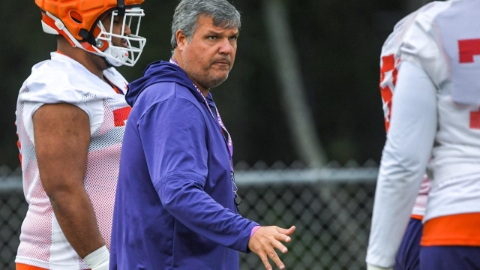
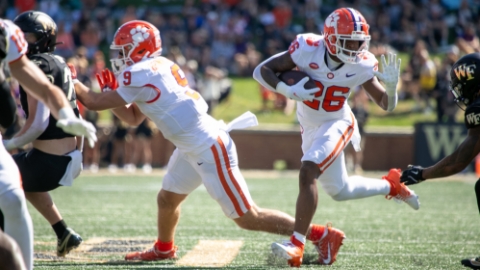
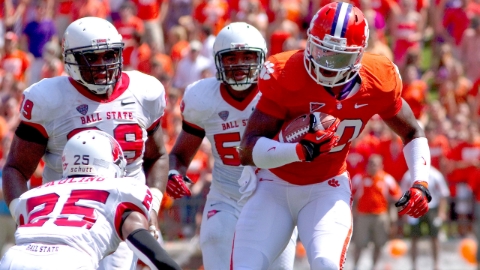
For Chad Morris, offense was never just about the play call itself. It was about the story you told before the ball was even snapped. During his four years as Clemson’s offensive coordinator, Morris engineered an attack that often left defenses guessing — Tajh Boyd faking a handoff before launching deep, Sammy Watkins in motion creating chaos, DeAndre Hopkins pulling safeties out of position. To the fans, it looked like an endless playbook. To Morris, it was something simpler: the art of “window dressing.”
During his recent visit to our daily radio show, I asked Coach Morris about current Clemson offensive coordinator Garrett Riley, noting that the pre-snap motion could be a “Catch-22” for the offense due to the changes the linemen might have to make.
“When you talk about what I do and the way we would run our system is, you know, I was all about the eye candy,” Morris said. “I was all about it because I felt like what it did for us — from the speed sweep motions to the misdirections in the backfield — I felt like it slowed the flow of the backers down.”
He paused, then clarified the term.
“I’m a firm believer, and I one hundred percent believe that — whether you call it eye candy, I call it window dressing, right? Whatever it is, you have to at least make those backers slow down or maybe make those backers have to false key. All I needed was for them to hesitate. Or maybe a safety needed to hesitate off of different motions that I would present.”
That half-second of hesitation was everything. In Morris’ view, it could turn a modest four-yard gain into a touchdown. To make it work, he designed motion that tested defenses without overwhelming the offense.
“You did it in a way to where it didn’t mess anyone up,” he explained. “We would have calls that they would work our O-line, and it was where — again, this is just the way we did it — but we always talked about our motion was called speed. And we would bring speed in any time I made a call to the O-line, or Tajh or Deshaun or Cole [Stoudt] made a call to the O-line, he would put speed and then call the play. That basically just told the O-line, ‘Look, the box is going to be changing. When motion happens, there’s going to be someone leaving the box, and there’s going to be someone entering the box. We called them “birds”. There’s gonna be a bird coming in the box and a bird leaving the box. We’re working up on tracks.’ And when you hear that speed, it just alerted the O-line: you’re not working to a man, you’re working to a level, and understand there’s going to be somebody there.”
It was controlled chaos — the picture for the defense was always changing, while the rules for the offense remained steady. To opponents, it looked complicated. To Clemson, it was just the same base concepts, dressed up differently.
“I loved the window dressing,” Morris said. “I think it really helped us in the run game. I think it also helped us in our play-action shot game, too, because it made the safeties have to flatfoot.”
That detail mattered. When safeties hesitate, they’re late to their run fits — and vulnerable to being beaten deep. For an offense with receivers like Watkins and Hopkins, even the smallest pause could open the field. It also played into Clemson’s tempo. By the time defenses adjusted to the motion, Morris wanted the ball already snapped. “Window dressing” wasn’t just about deception — it was about forcing opponents to process more than they could handle at the speed Clemson played.
As creative as Morris was, he emphasized that the system only worked because the staff continually reevaluated the demands placed on players.
That balance — between variety and clarity — was what allowed Clemson to grow under Morris, paving the way for the Tigers’ eventual national championship run as Tony Elliott and Jeff Scott took over the OC duties. Looking back, Morris sees “window dressing” as more than a gimmick. It was part of an offensive philosophy rooted in stress-testing defenses without confusing his own team.
“Whatever it is, you have to at least make those backers slow down,” he said. “And all I needed was them to hesitate.”
For a coach who helped Clemson modernize its offense, the lesson is still the same: football is as much about what players see as what they do. And sometimes the smallest shift — a motion here, a hesitation there — makes all the difference.