SUPPORT US. OUR SITE IS 100% OWNED BY A 2002 CLEMSON GRADUATE→ Get THREE Months of CST+ for just $1.00
College football has always been shaped by resources, but the postseason run by the Miami Hurricanes and the Indiana Hoosiers underscores how quickly the balance of power is shifting in the NIL era — and how uneven the playing field may soon become.
Both CFB Championship game participants' paths to the national championship have been impressive on their own merits: road wins in hostile environments, elite quarterback play at the right moments, and a physical brand of football that held up under postseason pressure.
But the larger takeaway goes beyond one team or one season. It speaks to a sport moving closer to a model where financial leverage can dramatically accelerate competitive relevance.
The traditional power structure was built through strong high school recruiting, along with occasional transfer acquisitions.
As leagues, the Southeastern Conference and Big Ten built their reputations on depth, volume, and perception, while the Atlantic Coast Conference and the Big 12 were often framed as a step behind. Postseason results this season have challenged that assumption, especially with what’s happened with the ACC and SEC.
The ACC has stacked wins against Power Four competition, while the Southeastern Conference has struggled to justify its inflated presence in the playoff field.
Then there is Indiana from the Big Ten.
Historically lowly, Indiana.
The Hoosiers are on the brink of an unprecedented season, with the potential to be the first 16-0 team in college football. That alone would be a compelling storyline. What makes this moment different is what comes next.
The emerging reality is that NIL has introduced a new variable that conferences alone cannot control: individual wealth concentration.
When a single donor can materially change a program’s ceiling, traditional timelines no longer apply.
In this era, rebuilds can be skipped via the transfer portal. Historical baggage can be erased. And programs that once relied on patience and development can buy speed.
For example, Indiana has Mark Cuban, while Oregon has Nike’s Phil Knight. Those two teams just battled for the final spot in the championship game.
And don’t get me wrong, it’s not all bad.
Indiana’s story has been great to watch, but the idea that college football has become the Wild West turns many fans' stomachs. Most aren’t against players making money at this point; it’s about having no cap and endless free agency through the transfer portal.
The example most often raised nationally is Texas Tech, where investment and alignment have fueled unprecedented success.
The Red Raiders' sudden rise, led by oil billionaire and Board of Regents Chairman Cody Campbell, symbolizes a future many in the sport are reluctant to confront: college football may be entering its “billionaire owner” phase.
When single donor-backed collectives can outpace traditional fundraising models by orders of magnitude, competition becomes less about geography or recruiting footprint and more about financial gravity.
In the past, a figure like Campbell might have put his name on the stadium. Now, he’s putting millions into the hands of 18-year-old athletes and the results are showing. Texas Tech landed the nation’s No. 1 transfer portal class last year and has surged in high school recruiting, currently ranked No. 7 for the 2027 class after finishing No. 21 in 2025 and No. 14 in 2026.
For programs like Clemson, the implications are significant.
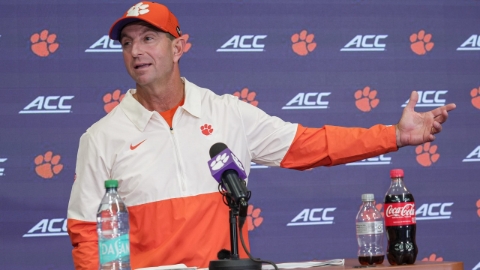
The Tigers’ rise under Dabo Swinney was built on stability, elite evaluation, and internal development. That model still matters, but it now exists alongside an environment in which competitors can assemble rosters rapidly through capital rather than through continuity.
The concern isn’t that money exists in the sport — it always has. The concern is scale and concentration, with no limits in place. Many fans are tuning out, as knowing who is on each team year to year is now worse in college sports than their professional counterparts.
The portal and NIL were sold as tools for player empowerment and competitive balance. Without guardrails, they risk becoming accelerants for inequality. This is where the sport’s leadership vacuum becomes most apparent.
Conferences can celebrate their records and playoff success, but they cannot insulate themselves from an arms race driven by individual wealth.
Miami and Indiana’s runs are both a celebration and a warning.
It shows what’s possible when alignment, talent, and resources converge. It also previews a future where similar runs become more common — not because of sustained program building, but because the financial floor has been raised overnight.
College football doesn’t need to eliminate NIL. It needs to define it. Because if the next era belongs to billionaire-backed programs, the question won’t be who won the national championship — it will be who ever had a chance to compete for it in the first place.