
100% independent. 110% Clemson.
Owned and operated by a 2002 Clemson graduate.
👉 Unlock THREE months of CST+ for just $1.00
If there's one Clemson player positioned to benefit the most from Chad Morris' return to Death Valley, it might not be a quarterback.
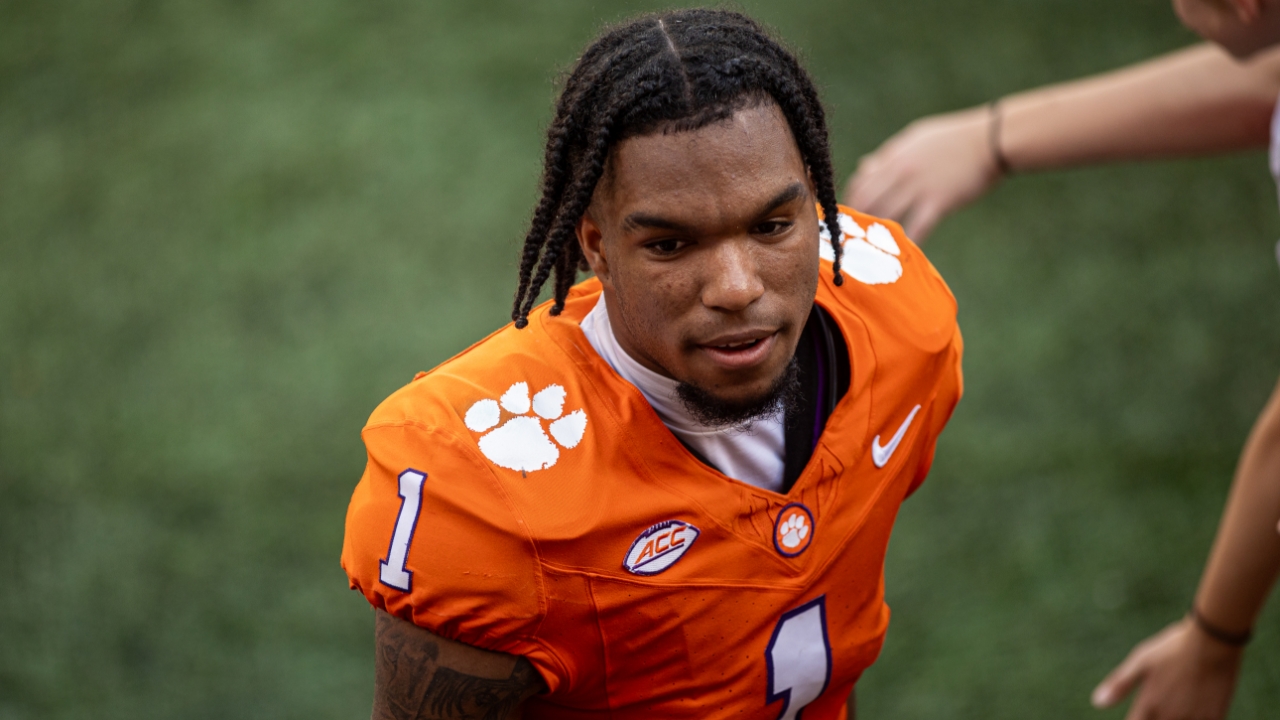
It might be T.J. Moore.
The junior wide receiver enters the 2026 season already with a résumé most Clemson receivers would envy. In just two seasons, Moore has caught 97 passes for 1,488 yards while becoming one of only four players in school history—joining Sammy Watkins, Artavis Scott and Justyn Ross—to eclipse 650 receiving yards in both his freshman and sophomore seasons.
Impressive? Absolutely.
But it still feels like Moore hasn't played his best football yet.
That's what makes this season so intriguing.
For the first time in his Clemson career, Moore will be operating in Morris’ offense, which is one that has historically turned elite talent on the outside into household names.
When Morris last coordinated Clemson's offense from 2011-14, wide receivers didn't simply put up numbers; they became stars.
DeAndre Hopkins developed into one of college football's most complete receivers before becoming an NFL All-Pro.
Sammy Watkins became arguably the most electrifying offensive player Clemson has ever produced at wideout, whose combination of speed, physicality and explosiveness helped change the national perception of Clemson football. He was named an All-American as a freshman, becoming just the fourth true freshman in NCAA history to garner the honor, racking up 82 receptions for 1,219 receiving yards and 12 receiving touchdowns.
Martavis Bryant became a vertical nightmare in the system. Charone Peake developed into an NFL Draft pick. Adam Humphries turned into one of college football's most dependable slot receivers before carving out a long professional career.
That wasn't an accident.
Morris built offenses around creating favorable matchups for his playmakers while attacking defenses vertically. His offenses demanded aggressive quarterback play and rewarded receivers capable of winning one-on-one battles downfield.
Sound familiar?
Because that's exactly the profile Moore fits.
At 6-foot-3 and 205 pounds, Moore has already shown he can be Clemson's premier boundary receiver. He doesn't need manufactured touches. He wins outside the numbers, attacks the football in the air and possesses the type of catch radius quarterbacks love.
His sophomore season provided plenty of reminders.
There was the 75-yard touchdown on Clemson's opening offensive play against North Carolina.
There was the spectacular one-handed, 62-yard touchdown against SMU that instantly became one of the highlights of Clemson's season.
There was another 75-yard score against Duke, making him the first Clemson player since Travis Etienne in 2019 to produce multiple touchdowns of at least 75 yards in the same season.
And when Clemson needed someone to make plays late in the year, Moore answered, finishing with 101 receiving yards against South Carolina before leading the Tigers with 83 yards in the postseason matchup against Penn State.
He finished 2025 with team highs in receptions (52) and receiving yards (837) while starting all 13 games, the only Clemson receiver to do so.
Those aren't flashes anymore.
That's consistency.
Still, there's another layer to this conversation.
The greatest receivers in Clemson history weren't simply productive—they became impossible to defend.
Hopkins reached that level.
Watkins certainly did.
Mike Williams became nearly uncoverable because of his size and ability to win contested catches.
Tee Higgins evolved into one of the nation's premier deep threats.
Justyn Ross looked destined to become the next superstar before injuries altered what appeared to be a legendary trajectory.
Moore has pieces of each.
Like Williams, he can overwhelm defensive backs with his frame.
Like Higgins, he naturally tracks the football downfield and has a knack for creating explosive plays.
Like Ross, he often makes difficult catches look routine.
Now comes the challenge every great Clemson receiver eventually faces.
Moving from "really good" to "the guy."
That opportunity is here.
Antonio Williams' departure to the NFL leaves behind far more than receptions. It leaves behind leadership, targets and the expectation that someone becomes Clemson's unquestioned No. 1 option.
Moore appears built for that role.
And he won't have to carry the load alone.
Bryant Wesco Jr. returns from a season-ending injury last year, giving Clemson one of the nation's best outside receiver duos.
In fact, Moore and Wesco are one of only three returning duos nationally to each total at least 1,200 receiving yards, nine touchdowns and average 15 yards per reception over the last two seasons.
Meanwhile, Tyler Brown is healthy after an injury-plagued 2025, Juju Preston generated some buzz late last season, and talented freshman Naeem Burroughs adds another explosive weapon to a room that suddenly looks as deep as any Clemson has fielded in years.
That's exactly the kind of receiver room Morris inherited and elevated the first time around.
Perhaps the most fascinating comment Morris has made since returning is his desire to take three deep shots every quarter.
Three.
Every quarter.
If he stays true to that philosophy, few players stand to benefit more than Moore.
He has already proven he can beat defenses vertically.
Now he'll have an offensive coordinator actively seeking those opportunities instead of waiting for them to develop naturally; Morris will create them through scheme and a running attack that keeps the defense honest.
That's an exciting combination.
The statistics suggest Moore has already become one of the ACC's premier receivers.
History suggests Morris knows exactly how to maximize players with Moore's skill set.
Put those two realities together, and it's not difficult to envision Moore joining the next tier of Clemson legends.
He has already established himself as one of the program's most productive young receivers.
The next step is becoming one of its unforgettable ones.
_68bedd63.png)