Clemson's Practice Problem: Why Aren't the Tigers Delivering When the Lights Come On?
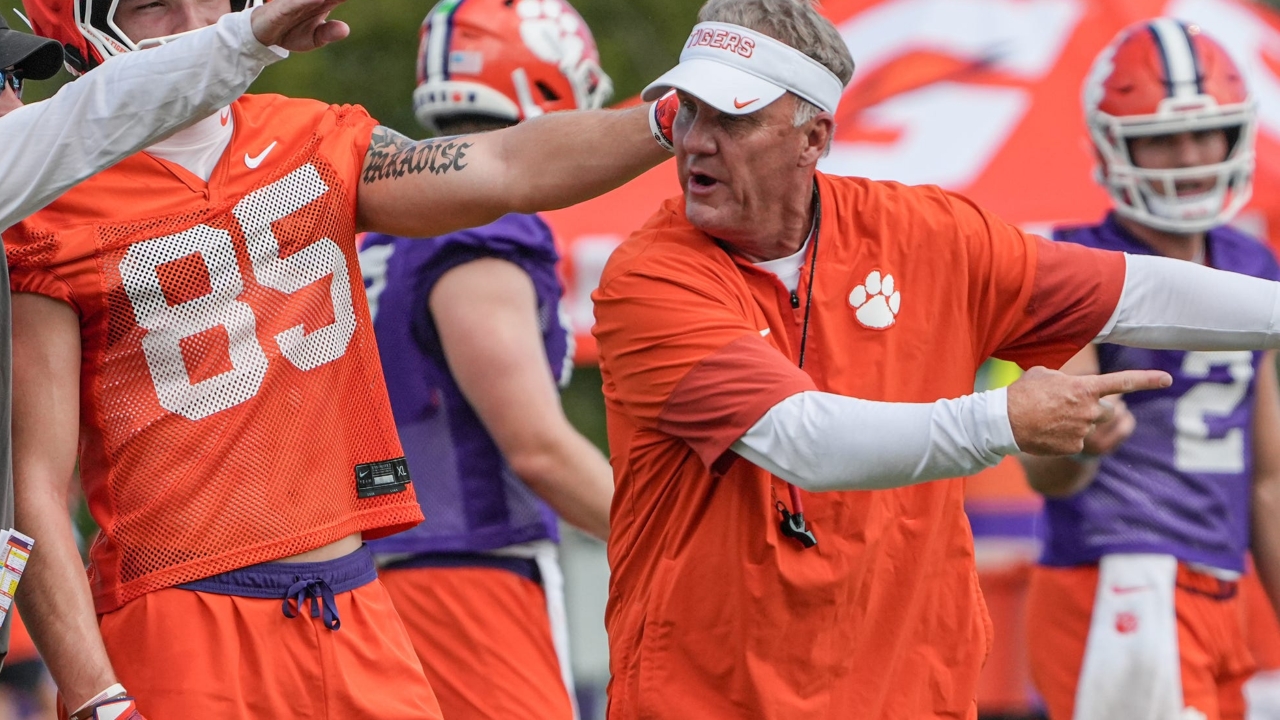
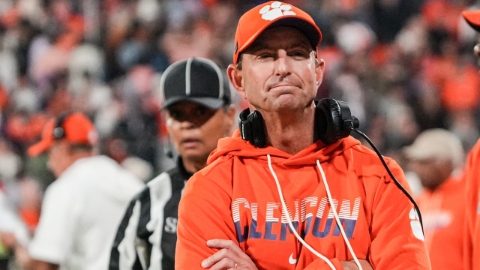
The Clemson offense Dabo Swinney watches during the week apparently bears little resemblance to the one that takes the field on Saturdays.
That's becoming one of the most troubling developments of the Tigers' 2026 season.
The assignments are executed. The preparation is encouraging. The progress, according to Clemson's coaches, is visible. Then the lights come on, the opponent lines up across the football, and the same mistakes that supposedly weren't happening during the week return.
Seven games into the season, Clemson is 4-3, and its offense remains a frustrating collection of missed opportunities, untimely mistakes and drives that produce field goals instead of touchdowns.
Following Saturday's 20-16 loss to Virginia Tech, Swinney again pointed to the disconnect between practice and game-day execution.
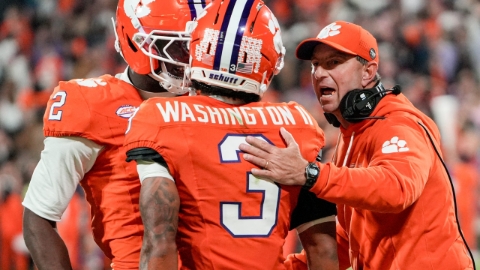
"That's the frustrating thing, is it's not what we're seeing in practice," Swinney said Sunday.
Perhaps the more revealing comment came days earlier, when offensive coordinator Chad Morris acknowledged the very same issue.
"If we can just take the way we practice and move it to the field, then things happen," Morris said.
But what happens when they can't?
At some point, the question becomes whether Clemson has a preparation problem, an execution problem, or something more difficult to diagnose: a group of players who struggle to perform at their best when the pressure is greatest.
There's an old saying in sports about certain athletes who become different players when the lights come on. They rise to the occasion, elevate their performance and deliver when the stakes are highest. The bigger the moment, the better they play.
But what about the opposite?
Is it possible Clemson has players who consistently perform well in controlled practice environments but struggle to reproduce that success when the pressure, speed and consequences of a real game enter the equation?
It's a fair question, especially when the coaching staff keeps describing an offense that looks far better during the week than on game day.
And the evidence is becoming increasingly difficult to ignore.
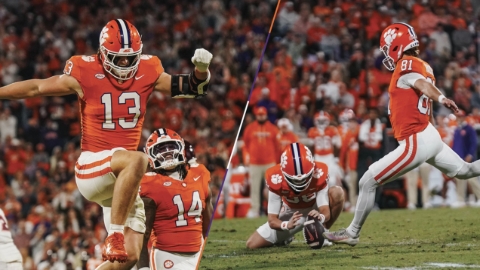
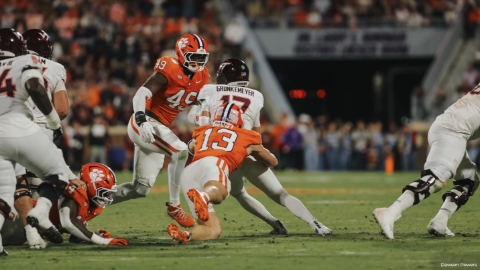
Against Virginia Tech, Clemson managed just 16 points despite a defensive effort that gave the Tigers an opportunity to win. The offense failed to capitalize on multiple scoring opportunities, including a fourth-and-inches situation and a stopped fake that left Clemson empty-handed in scoring territory.
The Tigers entered the fourth quarter with a lead, only to watch another winnable game slip away.
For Swinney, the frustration extended beyond the final score.
"We're nowhere near what we thought we would be or what we've worked to be or even what we've seen at practice," Swinney said.
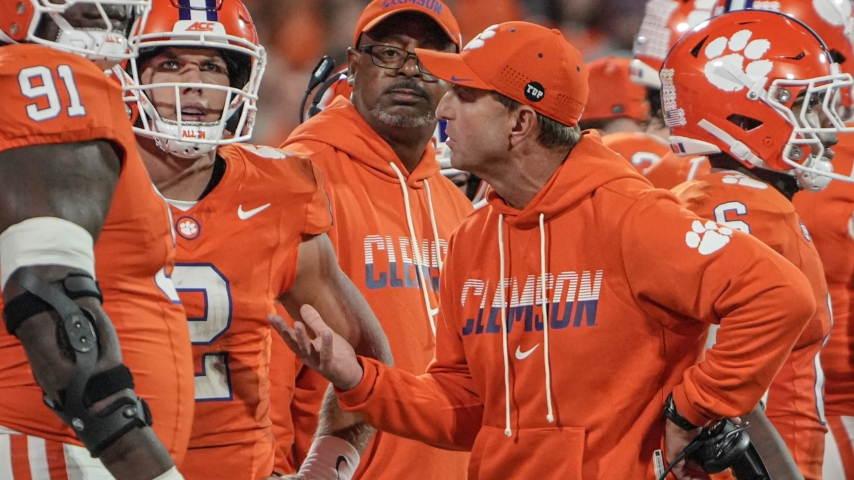
That admission raises a fundamental question about how Clemson evaluates its offensive progress.
If the Tigers are consistently executing during the week, why does that execution disappear on Saturdays?
Swinney described the breakdowns as a revolving door of mistakes rather than one particular weakness.
"We get the OL doing this right, then the tight end gets it wrong. Or we get the OL making the perfect block, and the running back doesn't run the track," Swinney explained.
"We get the quarterback right, and the receiver drops it. Or the quarterback's wrong. I mean, it's just musical chairs."
The description is revealing because it suggests Clemson's problems aren't necessarily rooted in an inability to execute individual assignments. Instead, the offense struggles to get all 11 players functioning correctly on the same play.
One player makes the right read, another misses a block. The offensive line creates an opening, but the running back takes the wrong track. The quarterback delivers an accurate throw, but the receiver fails to finish the play.
And when one problem gets corrected, another emerges.
That kind of inconsistency can be especially damaging to an offense already struggling to generate explosive plays. Without those chunk gains, Clemson must sustain longer possessions, increasing opportunities for something to go wrong.
Morris acknowledged that problem before the Virginia Tech game.
"Right now, that's one of the things we're lacking, is we're having to go on nine-, 10-, 12-, 13-play drives," Morris said.
"That's hard. You deal with 18 third downs. That's tough."
But there's another element worth considering.
In sports psychology, pressure can interfere with skills athletes have practiced thousands of times. As the stakes rise, players who execute instinctively in familiar environments can start overthinking, rushing decisions, or focusing too much on the consequences of failure.
It doesn't mean those athletes lack talent or toughness. It means the mental demands of competition can sometimes interfere with physical execution.
Morris offered an interesting glimpse into that possibility when discussing Clemson's red-zone struggles before Saturday's game.
"Again, that just blows my mind that you get down there and everybody gets so sped up," Morris said.
He explained that Clemson has attempted to address the problem by introducing distractions during practice.
"Those things, practicing with music and trying to just distract as much as we can when we get into our red-zone practices," Morris said.
The objective is understandable. Create an environment that forces players to concentrate, communicate, and execute while distractions compete for their attention.
But crowd noise is only one part of game-day pressure.
A practice rep doesn't necessarily carry the same emotional weight as a third down in a close game. A missed assignment on Wednesday doesn't produce the same consequences as a mistake inside the opponent's 10-yard line on Saturday night.
And perhaps most importantly, defenders in practice don't always present the same unpredictable challenges as opponents who spent an entire week studying Clemson's tendencies.
That creates two possibilities the Tigers must examine.
Are players struggling to execute under pressure, or are practice situations failing to replicate the challenges they face in games?
The answer could be some combination of both.
Clemson also needs to consider how it evaluates players and distributes opportunities.
"One of the greatest things that we could provide for all our players is competition. Competition. That's the greatest thing," Morris said.
He later explained how that competition can affect accountability.
"So when you can take playing time away from them, and you can put them on the sideline, things change a little bit."
That philosophy introduces another question for Clemson's coaching staff.
If certain players consistently perform well in practice but struggle during games, how much weight should Saturday's performance carry when determining who gets the next opportunity?
Practice performance matters. But ultimately, football games aren't played on the practice field.
At some point, the ability to perform when the consequences are real must become a defining part of the evaluation.
That doesn't mean Clemson should abandon players after mistakes or begin making wholesale personnel changes. Young players, particularly quarterbacks, need opportunities to develop through difficult experiences.
Tait Reynolds is a prime example.
The freshman quarterback completed 20 of 26 passes against Virginia Tech for 153 yards and added 63 rushing yards, including a 16-yard touchdown run. He showed progress in areas of his game, particularly his willingness to use his legs.
But he also made a costly mistake on Clemson's final offensive play.
Facing fourth-and-nine, Reynolds incorporated a play fake that Swinney said wasn't part of the design.
"No, that was not a play-action pass," Swinney said.
"I have no idea why he's P-faking. Ball should have been gone, should have taken a drop, and he had the crosser, he had T.J. Moore, and they got us on a corner cat."
It's a small example of a much larger issue.
He needed to execute the play that had been called.
And that has become Clemson's recurring offensive challenge: making routine plays routinely.
The issue isn't confined to the quarterback position, either.
"We got to help him. We got to help this kid out. That's all positions," Morris said. "That's been my challenge to our guys. Let's help out the guy back here that's making this thing happen."
Those comments become even more significant when paired with Swinney's Sunday assessment.
The head coach refused to question Clemson's talent evaluation when asked whether the staff might have misjudged the offensive personnel entering the season.
"No, I think it's on us as coaches. I just think I've got to be better," Swinney said. "We got good players. We got good enough players."
Swinney also expressed unwavering confidence in Morris.
"Nobody works harder than Chad. He's smart. He's detailed. It just hasn't come together."
That leaves Clemson in an increasingly uncomfortable position.
The head coach believes in his players. He believes in his offensive coordinator. He believes the preparation is producing results during the week.
Yet the offense continues to struggle when those results matter most.
The staff must evaluate whether its practices adequately prepare players for game-day pressure while distinguishing mistakes caused by inexperience from those tied to preparation. That could mean increasing competition and accountability, simplifying assignments or giving other players opportunities to prove themselves on Saturdays.
None of those adjustments guarantees an immediate turnaround.
But continuing to practice well without producing better results on game day isn't much of a solution, either.
The Tigers have five regular-season games remaining, beginning with Saturday's trip to Florida State. The offense still has time to improve, and Swinney remains convinced better days are ahead.
"We're going to get better. We're going to get better," he said Sunday.
Perhaps they will.
But seven games into the season, Clemson's most important offensive question may no longer be whether its players can execute the system.
It's whether they can execute it when the lights come on.
Because the scoreboard doesn't care how well you practiced.
— Swanny