By the time the lights hit in Death Valley, the game will already be slow in Cade Klubnik’s head. That’s the difference now.
A year ago, heading into the opener in Atlanta against Georgia, the buzz was uneasy. A few errant throws. A red-zone misread. A sputter in tempo when Clemson needed a spark as a sophomore. The fanbase didn’t say it outright, but you could feel some doubt in the stands; heck, I heard it on my daily radio show. Could Klubnik be the guy? For a program used to quarterbacks arriving polished and leaving as legends, the whispers landed louder than they should’ve.
Inside the building, though, offensive coordinator Garrett Riley never flinched. He saw something steadier taking shape. Not the kind of brilliance that lights up highlight reels, but something better: command. Ownership. The quiet growth of a quarterback learning to control the game, not chase it.
“I’ve said this all along, I’ve said it to his face,” Riley says now. “There’s another level for him, and that’s what he’s chasing. That’s what we’re all chasing.”
He’s not talking about arm strength. Not talking about the deep ball or scrambling highlights. The real leap comes in the routine. The five-yard out that has to hit every time. The check at the line that dodges a blitz before the fans even know it was coming. The small things—the ones you barely notice unless you’re watching from inside the huddle.
“You make those routine plays every time,” Riley says, “because you’re that caliber of player.”
That’s the charge he gave Cade this offseason. Not to reinvent himself. Not to be the next Deshaun or Trevor. Just to be the version of himself that hits the simple things with such consistency, everything else unfolds from it.
It’s easy to forget how much has changed in a year. Klubnik came into 2023 with hype but little rhythm. His mechanics needed refining. His reads sometimes lagged a beat behind the defense. He wasn’t struggling—he was still learning. And it didn’t help that everything around him was shifting, too.
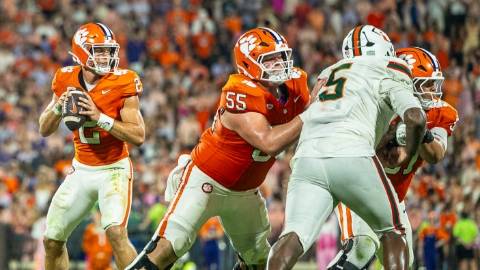
But last fall, something was different. The game slowed down—not because Cade was coasting, but because he was in control. In red-zone situations, Riley gives him full authority to make checks at the line. That kind of freedom doesn’t come from talent alone. It comes from trust. From reps. From hours behind closed doors, studying, asking questions, running scenarios until it becomes instinct.
The confidence isn’t just with Cade—it’s across the entire offense. The linemen have taken hundreds of snaps with him. The receivers know his timing, his language. And Hunter Helms—now a player-coach—still sits in on meetings, a familiar sounding board in Cade’s corner.
The transformation hasn’t been dramatic. It’s been layered. Intentional. Riley speaks about Klubnik not with fireworks, but with warmth, like someone watching a kid finally grow into his skin.
Outside the walls, the narrative has flipped. The same analysts who doubted Cade now call him a potential No. 1 overall pick. Inside the building, the expectations haven’t changed—they’ve just matured. Riley talks about this season like a slow crescendo. There’s no rush. The game, like Klubnik, will unfold at its own pace.
Cade, for his part, sees the growth clearly, but not like some highlight montage. It’s internal, unfinished. “When it comes to my mindset, I’m just trying to be the best self I can be,” he said during our interview at the ACC Kickoff. “I want to be better. This year, I’m just trying to outwork last year’s version of me. That was kind of my mindset.”
He doesn’t dodge the work. If anything, he looks for it in the offseason’s quietest hours. “Whether it’s February 20th—when nobody cares about college football—I’m trying to outwork last year’s version of myself.”
When I asked if it felt like he was chasing a ghost, he smiled. “I don’t feel like I’m trying to chase him,” Cade said. “I’m trying to beat him right now.”
While the running back room rotates and the receiver group battles injuries and reps, Cade is the constant. He leads not by volume, but by consistency. By presence. By the quiet assurance that if he’s behind center, Clemson has a shot.
“We’re still a hungry team,” Cade said. “A team that’s been through the fire… through the ups and downs. So, we’re just putting our heads down to go to work.”
When LSU comes out swinging this Saturday—when Harold Perkins starts flying off the edge and the stadium pulses with noise—Riley knows exactly what Cade will be doing.
Breathing. Seeing it all before it happens.
Because now, finally, the game is as slow as he needs it to be.