A Familiar Struggle: Clemson Can’t Find Offensive Rhythm in Season Opener

TAKE ADVANTAGE → Get THREE Months of CST+ for just $1.00
For the third straight year, Clemson opened its season with an offensive dud. Saturday’s 17-10 home loss to LSU marked the latest chapter in a troubling trend under offensive coordinator Garrett Riley: sluggish, uninspired performances out of the gate.
Year 1 of the Riley era began with a 28-7 stumble at Duke, a game marred by missteps. Year 2 opened with a 34-3 thrashing at the hands of Georgia in Atlanta. And now, in Year 3, despite playing inside Death Valley with a senior quarterback and veteran playmakers, the Tigers again couldn’t generate consistent results on offense.
None of the expected explosiveness showed up against LSU. It was unsettling to watch the group struggle—regardless of how good the visiting Tigers might be, and some believe they might be ranked No. 1 when the polls come out later today. We shall see.
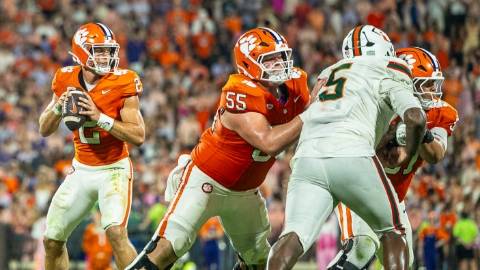
As for Clemson, quarterback Cade Klubnik, who was praised all offseason for his growth and dual-threat ability, managed just one net rushing yard after accounting for sacks. He had two 5-yard carries and two 7-yard gains, but Riley’s much-discussed “X factor” quarterback run game never materialized.
That disconnect is striking given Riley’s words as camp opened:
“I think the sky's the limit. I mean, that's what we're preaching to our guys. I just think there's so much more there for him, for us offensively, and for our team. There's just so much there, and there's still so much room for growth.”
On Klubnik’s running ability, Riley doubled down:
“That's the X factor, right? I mean, when you have an element like that, that quarterback can have a Plus-1 or just create on his own. That's a significant problem for defenses. It's gonna help throughout the season. He's a guy that made a big jump from year one to year two, just with the run game part and what we asked him to do. I think physically, as he's matured and gotten better as well, that's been a big contributing factor to that.”
Clemson’s offense felt like it was going to have a lot of versatility with Adam Randall moving from wide receiver to running back. You could imagine flanking Randall out of the backfield to create mismatches. Or perhaps you could see the Tigers lining up with Randall out wide and bringing him into the backfield, creating havoc for defenses trying to match the Tigers’ versatility.
But in this year’s opener, Randall and the backfield rotation couldn’t find traction against LSU’s front, and we rarely saw him utilized to take advantage of the Bayou Bengals personnel.
If that felt odd to you, you aren’t alone.
Riley, entering this season, has the benefit of continuity—most of his offensive core, including Klubnik, WRs Antonio Williams, T.J. Moore, and Bryant Wesco, as well as the offensive line, have played extensive snaps together.
“You've got a guy that's just been through it. We've got a lot of people on our side of the ball that have played together and have continuity in chemistry from that standpoint,” Riley said recently. “They played a lot of snaps together. They've been through ups and downs together. We're all gonna draw from our own experiences. I think we got a group that can certainly do that and apply that into Game 1 like we're about to have.”
Instead, what unfolded against LSU felt too familiar: safe, predictable calls, a lack of designed creativity to scheme receivers open, and drives that stalled before rhythm could take hold.
It’s not that Riley’s system can’t score—at times over the years, it has flashed and feels like most people hoped it would when Swinney hired him from TCU.
However, more often than not, questions abound about who was really calling plays for the Horned Frogs, and whether Sonny Dykes was really the offensive guru in Fort Worth. Watching TCU roll up 48 points last night in their season opener against North Carolina didn’t help the narrative. In fairness, the Horned Frogs did have two defensive touchdowns with a pick-six and scoop-and-score fumble return.
Back in Clemson, however, the issue is timing. The Tigers haven’t looked ready in Week 1 under Riley, and with Playoff aspirations, those opening losses create concern, not because of who the Tigers played, but how they played.
Georgia in 2024 and LSU this past weekend are playoff-worthy opponents, but Clemson is also supposed to be one. Yet, after all the opening weekend losses, it just feels disconnected—again.
Clemson fans are left asking: Where’s the innovation Riley was hired to bring? Why does this offense still look reactive instead of proactive on the biggest stages? Aggressive and attacking? Far from it, this past Saturday, and bailing on the ground game didn’t help.
Head coach Dabo Swinney didn’t sugarcoat things on his radio show Monday night when asked about the lack of a ground game:
“We just didn’t commit to the run. I think we only had 15 run calls out of whatever—60 plays. So we just did a poor job as coaches. Adam Randall had one carry for six yards in the second half—his only carry. Just a poor job. Didn't give the run game a chance, outside of a few plays, that's on us as coaches.”
The schedule offers a chance to reset against Troy, but the matchup against Georgia Tech is going to be tough, especially if Riley can’t find his rhythm as a playcaller. His third year may be defined less by Clemson’s ceiling and more by its recurring inability to start strong.
Losing 17-10 against LSU in Week 1 isn’t the end of the world, but it’s how things looked—and felt—that has concerned so many Clemson fans.
Until the Tigers find a way to translate offseason promise into early-season execution, every September setback will feel heavier than it should. For Riley and this offense, the challenge isn’t proving they can put up numbers in October or November—it’s showing from the very first snap that Clemson belongs in the conversation with the very best.
Clemson Offensive Stats vs. LSU