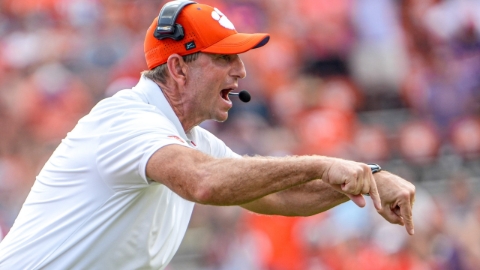
Dabo Swinney Pushes Back on Critics: 'We're Trying to Build Our Way Back to the Top'
Dabo Swinney isn't pretending Clemson is where it wants to be. But he's also not interested in allowing critics to define how the Tigers should find their way back.
During Tuesday's press conference ahead of Clemson's homecoming matchup against Virginia Tech (5-2, 2-2), Swinney delivered one of his more passionate defenses of the program's direction, pushing back against questions about his developmental philosophy and whether his approach still works in an era increasingly shaped by the transfer portal and player compensation.
His message was unmistakable: Clemson is rebuilding toward the standard it established under his leadership, but Swinney isn't abandoning the principles that helped the Tigers reach college football's summit.
"We're trying to build our way back to the top. You don't get to stay there," Swinney said.
That admission may have been the most revealing part of his response.
For years, Clemson was the program others were trying to catch. The Tigers became a fixture in the College Football Playoff, captured two national championships and established a level of consistency few programs in college football history have matched.
Now, the conversation has changed.
Instead of discussing how Clemson maintains its position among the nation's elite, Swinney is explaining how the Tigers (4-2, 2-1) intend to reclaim it.
Increasingly, that conversation centers on whether the methods that built Clemson into a national powerhouse remain sufficient in today's rapidly changing college football landscape.
Swinney was asked directly what being a developmental program means in an era when teams can use the transfer portal to acquire experienced players.
"Well, whoever we bring in here, we’ve got to get them better. I mean, we’ve got to develop them," Swinney said.
His explanation wasn't limited to high school recruiting. Swinney pointed to sophomore Donovan Starr, veteran transfer Elliott Washington II and freshman quarterback Tait Reynolds as examples of players who require continued development regardless of how they arrive at Clemson.
The distinction matters because Swinney isn't rejecting the portal. He's arguing that acquiring players and developing them aren't mutually exclusive.
He also made clear that high school recruiting remains the foundation of Clemson's approach.
"That's where it starts for us," Swinney said, explaining that the Tigers will continue recruiting high school players they believe fit their program before filling needs through the transfer portal.
The more pointed exchange came when a reporter suggested critics view Swinney's philosophy as outdated, particularly when other programs are using player compensation and the portal to accelerate roster improvements.
Swinney immediately challenged the premise that Clemson isn't participating in the financial realities of modern college football.
"Ain't no players coming here for free. They don't go anywhere for free," he said.
Then came a lengthy defense of his commitment to Clemson and his unwillingness to let outside criticism dictate his decisions.
"I can't control what people say. I don't consume it. I control that," Swinney said.
He emphasized that his responsibility extends beyond producing one successful season. His objective, he explained, is maintaining a program capable of winning consistently over time.
That distinction is central to Swinney's argument, but it also exposes the tension between his philosophy and the expectations surrounding Clemson football.
Building for the long term sounds reasonable. Developing players remains essential. And few coaches have earned more credibility on either subject than Swinney.
Still, Clemson fans aren't simply asking whether the Tigers have a healthy program. They're asking when that program will consistently produce the kind of football they grew accustomed to watching during Clemson's championship years.
The difference between those questions is significant.
Clemson's 41-13 loss to Miami earlier this month showed how far the Tigers still are from the nation's elite. Saturday's 37-0 victory over Charleston Southern offered encouragement, but beating an overmatched opponent doesn't necessarily answer the questions raised against stronger competition.
That's why the upcoming stretch of ACC games carries so much importance.
Swinney believes his team is improving. He has praised Reynolds' development, expressed confidence in Clemson's young players and repeatedly suggested the Tigers have yet to play their best football.
But improvement and championship contention aren't automatically the same thing.
For a program that spent years measuring itself against Alabama and the nation's best, the standard remains considerably higher than simply showing progress.
Swinney understands that history better than anyone.
"We've been at the top of this mountain in this league nine times, and we're trying to build our way back one day at a time, one play at a time, one offseason at a time," he said.
His confidence in that process hasn't wavered publicly, even as the sport around him continues to change.
The transfer portal has reshaped roster construction. Player compensation has created new competitive pressures. Programs can now address weaknesses with experienced additions rather than waiting multiple seasons for younger players to develop.
None of that eliminates the importance of coaching and development, but it raises a legitimate question about how quickly a program can afford to rebuild.
For Clemson, that question matters because the Tigers aren't starting from the bottom. They're trying to return to a level they once occupied routinely.
And while Swinney can point to his program's championship history as evidence that his methods work, the next chapter will ultimately be judged by what Clemson accomplishes in the present.
The Tigers enter Saturday's matchup against Virginia Tech still in contention for a run at a conference championship game.
That opportunity makes Swinney's message immediately relevant.
He isn't asking Clemson fans to abandon championship expectations. He's asking them to trust the process he believes can get the Tigers back there.
The challenge is proving that the process can deliver results in a sport that increasingly rewards immediate improvement.
Swinney has spent much of his career demonstrating that Clemson belongs among college football's elite. Now he's trying to prove the Tigers can get back there without abandoning the identity that helped build their success.
His track record deserves consideration. So do the questions surrounding Clemson's current trajectory.
As the Tigers prepare for Virginia Tech, the answer won't come from another passionate defense of the program.
It will come from what Clemson does on the field.